
🎨 The Tale of Brown Kraft Paper (and Other Forensic Art Habits)
Written back on November 16, 2025
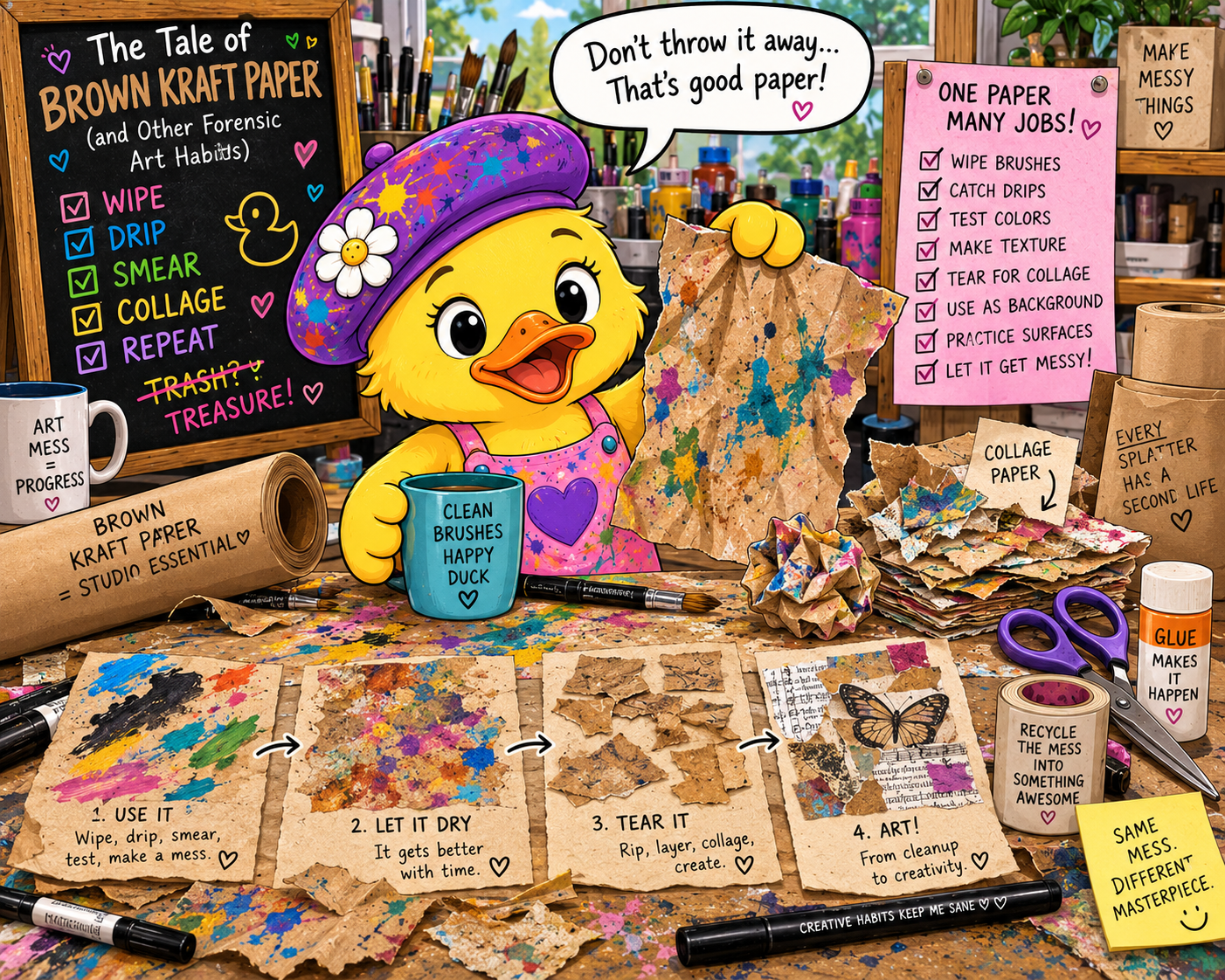
🐥 A quick note: Yes, the silly Painter Duck illustrations in this post were created with AI. They’re here to make you smile. I use AI as one of many creative tools, alongside my paintbrushes, colored pencils, and increasingly bassackwards business decisions. Nothing says professional artist quite like writing your doctor’s appointment on your catch-all craft paper.
Let’s be clear: I don’t study art. I stalk it. Every video tutorial is a crime scene, and I’m the detective with paint under my fingernails, a magnifying glass in one hand, and three cups of cloudy rinse water sweating on the desk. I don’t just watch art classes. I dissect them.
Yes, I take them to learn, but I also need to know exactly what supply is being used—exactly when. A lot of early tutorials didn’t even list their materials. And even now, some artists—no names—keep about fifty pencils rolling around on their desks like jumping jellybeans who got into their dad’s Adderall stash. Then they’ll casually grab one mid-lesson, and I’m over here squinting at the screen, whispering: “Is that Arteza Plum? Or Amethyst? Or one of the Holbein purples that all look identical?!”
And of course, this never happens in real time. Nope—everybody loves to fast-forward through the actual painting part. Suddenly, the pencils are teleporting around the page like grasshoppers on espresso. One second it’s at the top, next it’s bottom right, then—poof—off-screen entirely. The brush jumps too. Blink, and the background’s finished. And for the love of acrylics, there’s no commentary—just elevator music and chaos.
If you’re going to grab something, zoom out so we can actually see it. Don’t stay close on the canvas while your hand darts off-screen grabbing mystery supplies like a magician hiding secrets. Keep your frame wide enough that people can follow what you’re doing. And if you’re going to sweep half your desk into the shot, at least slow down and tell us what it is.
Look, if I wanted to watch someone paint, YouTube exists. But if I’m paying for a lesson—especially a $250 one—I expect detail. I expect you to be so thorough you could be audited by the IRS. You’d better have all your ducks (pun absolutely intended) and all your colors lined up. Tell me the brand, the number, the exact shade of purple you just used while the rest of us mortals are still mixing beige. And honestly? I hope an artist reads this and thinks, “Oops, that’s me.” Because it probably is.
If you’re charging real money for art education, slow the F down. Don’t race your brush to the finish line for a quick buck. Teaching art isn’t a sprint—it’s a responsibility. People are paying to learn, not to watch another sped-up montage. Some of us are the “little people.” Some are the grandmas who can’t see well but still want to paint. We don’t need dramatic close-ups of cheeks and eyelashes—we need to see the whole canvas, the background, the process, the why. Otherwise, we might as well be watching free speed-paint reels on Amazon.
That’s why it can take me days before I even start a lesson. Everyone else paints in an hour; I’m still decoding what mystery violet flashed across the screen at 3× speed. It’s not that I’m obsessed with color theory. It’s that I want to paint what I see—exactly how I see it. That’s the borderline in me. The OCD. The detail addict who refuses to settle for “close enough.”
That’s why when I paint from art classes, my pieces often look almost identical to the instructor’s. It’s not copying—it’s replication science. I want to understand how they did it, down to the brush pressure and pigment ratio, before I twist it into my own.
And yes, I do mix colors—but not because of color theory. Oh no. When you’ve got three wet palettes loaded with twenty to thirty drops of paint each, there’s no theory happening. There’s just chaos chemistry. Nobody—including me—knows what’s being mixed with what. It’s the kind of setup where if someone walks in mid-session, they just stop and ask, “What the hell are you doing?” And I say, “I don’t know, but it’s gonna work. Watch and wait.”
Between all those palettes, I’ve probably got a hundred paints in play at once. Do I know which ones they are? No. Do I remember which one was purple? Also no. I grab something close, slap it down, and if it’s wrong—boom—happy accident. Bob Ross would be proud, though he’d probably tell me to calm down and use fewer reds.
And I track all of it.
I have a massive swatch system—a full-blown color field guide. I take screenshots of the artist’s palette, match each color in my paints, and record it in my swatch book of evidence. Every lesson gets its own page, with notes on which exact paints and pencils were used and how they behaved. Once I’ve nailed the color match, those screenshots are gone—deleted. I don’t keep archives out of respect for the instructor and their work. The lesson served its purpose, and I move on with my notes, my swatches, and whatever beautiful disaster I just created.
That’s also why I keep brown craft paper on my desk. Not for looks. For survival.
You can buy a giant roll for next to nothing—it’ll last a year. I tape it down with blue painter’s tape and it becomes my everything surface: a notepad, a blotter, a chaos map. It’s covered in notes, color names, doctor’s appointments, doodles, grocery lists—basically my brain in brown kraft paper form.
If you want to take it a step further, throw a layer of gesso on top and use it as your test page. You don’t need fancy watercolor or mixed-media journals—they’re expensive, and this works better. As I watch a class, I jot down every color name, every pencil number, and then swatch directly onto the brown paper—sometimes over the gesso, sometimes not. It’s quick, cheap, and real.
But here’s the rule: don’t even think about recording videos with it in the background.
That paper reflects light like a disco ball in witness protection—brown one minute, beige the next, then gray, dark brown, mid-tone, and somehow purple if you stare long enough. You’ll spend hours color-correcting.
🕵️ Closing Argument
So yeah, call me obsessive, but at least I’m thorough. I’ve got more detective work in my studio than in most true-crime podcasts. Between the swatch charts, the palettes, and the paper evidence piling up like case files, I could probably solve a murder if someone dropped a clue in acrylics.
And if you ever forget to list your supplies in your own art video, don’t worry. Detective Hayley is on the case. Just remember to actually show them on camera—because even I can’t identify a paint tube that never made it into frame.
Now, if you’ll excuse me, I have a rubber duck wearing glasses staring at me like he’s disappointed again.
“Brown Paper Gospel”
I don’t chase theory. I chase proof.
Paint splatters tell me what’s true.
Palettes loaded. Colors stacked.
Every mix a case I cracked.
If you don’t take notes, don’t think I won’t notice.
This brown paper remembers what you forgot and posted.
— From the desk of Disorderly Studio, where brown craft paper is sacred, evidence dries fast, and the artist never really does.
Next Case: Art Class Crimes — where the detective finally puts bad tutorials on trial.